Philosophy
“Once, men turned their thinking over to machines in the hope that this would set them free. But that only permitted other men with machines to enslave them.”
– Frank Herbert, Dune
Originally Published August 7th 2026
For a more detailed breakdown on ways I interact with LLMs, see my personal code of LLM usage.
Several years ago when all of this was new and the only real model out there was ChatGPT, I sat down intending to try out the LLMs coding capabilities and found that the function I asked it to generate was there, and “worked”– except that I had failed to consider an edge case and failed to answer a question for myself about the actual behavior of the function should be. I had skipped over all of the thinking that would have gone into discovering those edge cases nuances in the first place, and that was about the point I started to depart from anything remotely related to what the industry would eventually call “vibe coding”. I already have a good process for rigorously exploring the ideas I want to implement “it’s called code”:
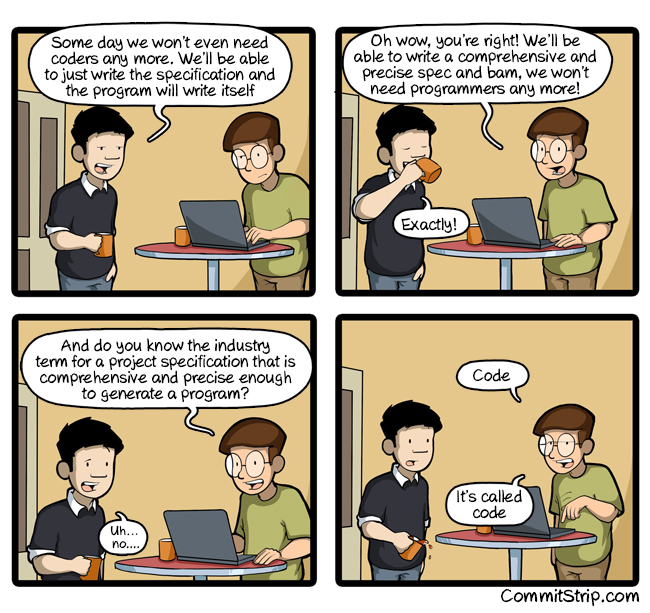
I get the appeal. It’s exciting to get to the meat of an issue right away and skip what often feels like mundane details and boilerplate. I also get the appeal of the credit card offers that keep getting mailed to me, but more debt (technical or otherwise) isn’t something I’m really interested in at this point in time– and thus far LLMs handed full agency over a codebase seem to be a sure way of getting that faster. There are better ways of getting through boilerplate than quite literally rolling the dice on what are inevitably going to be non-rigorous descriptions of problems that you seek to solve, and ultimately what makes a person valuable in this process is that they can get that understanding. I think there are legitimately good uses, but I’m not sure the good coming out of them outweighs the potential power and environmental cost just yet.
I have mixed opinions overall on LLMsHowever, I consider the en masse destructive scanning of books (see the court ruling here)– regardless of their rarity or content– to be among the greatest evils that has come from the recent LLM oriented age. To say nothing of outright stealing written text with willful disregard to its ownership. It seems that further details are needed as to what exactly is going on, but it looks pretty bad.
. They are undoubtedly a part of my life and workflows now in several ways, although lately I’ve found increasing dissatisfaction in interacting with them.
Mostly I’m in a position right now where I get to make extremely specific choices about how I interact with these systems. I realize not everyone does, and I may not be for forever.
When I do interact with LLMs, It’s often through a self hosted proxy like LibreChat or similar projects. If I’m using an agent of some kind with access to the filesystem I have a containerized environment I allow it to live in, and I bind mount the portions of the file tree I consider it appropriate for it to access.
Truthfully though, most of my career and education at this point has been oriented around the philosophy that I am best able to produce real, high-quality things when I’ve taken time to learn about something the hard way and really understand it. The devil is in the details, and in very common ways to use LLMs they tend to actively encourage patterns of thought that prevent me from getting the depth of knowledge about a new system that I would like. Where I’m able to make realistic choices in my career and life to avoid their use in that way, I do so.
“Is the LLM helping me think about this problem more, or less?” is the general filter I tend to pass my interactions with these tools through, and as long as it’s in my power to do so, that’s what I’ll emphasize.
I find the the process of creating something to be valuable both in its details, as well as holistically. I consider both writing and programming to be some of the best means toward that end. I won’t claim to be a purist, or even to hold to this philosophy perfectly at all times, but I consider it the ideal to strive for.